

The Gutenberg Parenthesis is Closing
Get In Loser, We're Going Post-Literate

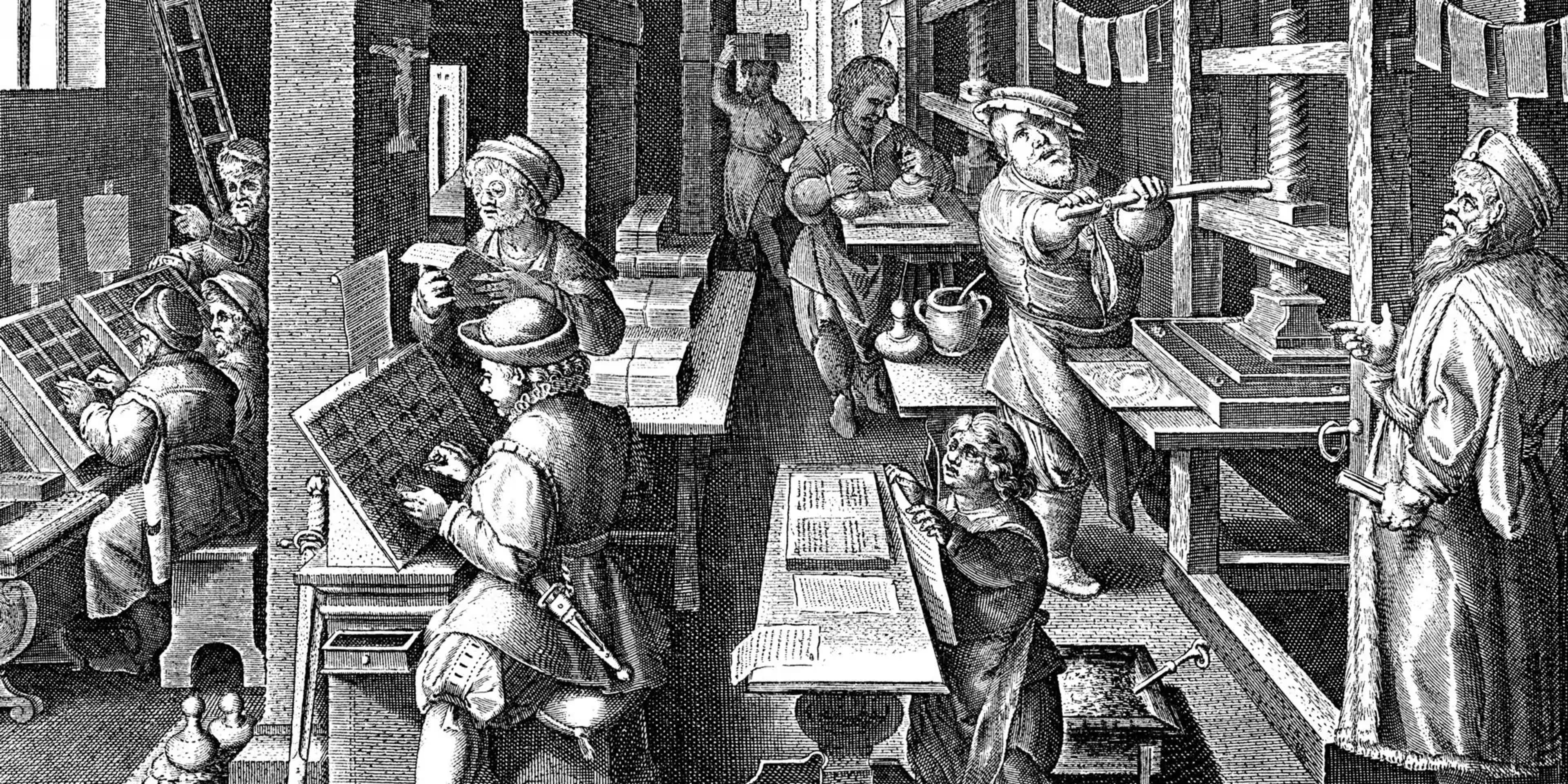
For roughly 570 years, humanity ran an experiment in information transmission: literacy. The written word and the document, the careful and structured transfer of ideas from one mind to another through the precise arrangement of symbols on a surface.
The experiment worked out OK.
It produced the Scientific Revolution, the Enlightenment, the modern university, constitutional democracy, the novel, the newspaper, the contract, the treaty, shitposts by dril, poems by T.S. Eliot, and the operating manual for your dishwasher. It created a world organized around texts.
Thomas Pettitt, a Danish scholar of medieval literature, coined the term “Gutenberg Parenthesis” for this period. A parenthesis opens, and then it closes. What comes between is an interruption, a departure from the main flow, a special mode that eventually ends. Pettitt argues that the five and a half centuries between Gutenberg’s printing press and the smartphone are a parenthetical aside in human communication history. Before the parenthesis opened, knowledge was fluid, oral, performative, and communal. After the parenthesis closes, knowledge will be fluid, oral, performative, and communal. The age of the fixed text was the anomaly, and we’re returning to the norm.
I find this argument uncomfortable, because I’ve organized my entire life around reading and writing. But discomfort isn’t a counterargument, and the evidence that the parenthesis is closing is accumulating faster than I can object to it.
What Socrates knew
Our best record of Socrates’ philosophy comes from Plato’s dialogues, which Plato wrote down. Socrates’ famous warning against writing survives only because someone ignored it.
In the Phaedrus, Socrates tells a story of the Egyptian god Theuth, who invented writing and presented it to the king Thamus as a gift that would improve memory and wisdom. Thamus wasn’t impressed. Writing, he said, would produce forgetfulness in the souls of those who learned it, because they would rely on external marks rather than their own internal resources. People would have the appearance of wisdom without the reality, and they would seem to know many things while actually knowing nothing.
Socrates compares written words to paintings: they seem alive, but if you ask them a question, they maintain a solemn silence. They can’t defend themselves or adapt their message to the audience. They roll around everywhere, falling into the hands of people who have no business reading them, unable to distinguish friend from enemy.
For most of the Gutenberg Parenthesis, educated people treated Socrates’ warning as a charming bit of ironic misdirection. We assumed he was being playful or that he simply couldn’t imagine the possibilities that print would open up. But what if he was describing the trade-offs accurately? What if writing really did externalize memory at the cost of internal cognitive capacity, exactly as he predicted, and we’ve spent five centuries slowly discovering this truth?
The oral mind and the literate mind
Walter Ong, a Jesuit priest and scholar who died in 2003, spent his career studying the differences between oral and literate cultures.
Oral cultures favor aggregative rather than analytic thinking (not “the brave soldier” but “the brave soldier and his trusty steed and his gleaming sword”). They’re redundant and copious because you can’t go back and reread a conversation. They’re conservative because, without writing, innovative ideas are hard to preserve, and the community’s energy goes into memorizing and repeating what already exists. They’re close to the human lifeworld, organizing knowledge around memorable activities and events rather than abstract categories. They’re agonistically toned, favoring verbal combat and elaborate insults as forms of intellectual discourse. They’re empathetic and participatory rather than objectively distanced. They’re homeostatic: they shed memories that are no longer relevant rather than accumulating archives.
Read that list again and tell me it doesn’t describe the internet.
The meme is aggregative (it accumulates references and variations), redundant (the same template repeated with variations), close to the human lifeworld (always rooted in relatable situations), agonistically toned (the ratio, the dunk, the clap-back), empathetic and participatory (you’re supposed to share and remix), and homeostatic (yesterday’s memes vanish from collective memory as efficiently as yesterday’s oral traditions). When teenagers communicate primarily through TikTok videos, audio clips, reaction GIFs, and voice memos, they’re reverting to something older and, in evolutionary terms, more natural.
The bottleneck problem
Text is a compression format. To convert an idea from its native form (the messy, associative, emotionally-tinged, contextually-embedded pattern of neural activity that constitutes human thought) into writing, you have to squeeze it through a narrow channel. You have to linearize what isn’t linear, make discrete what isn’t discrete, strip out tone and gesture and facial expression and shared context, and hope the person on the other end can decompress it accurately.
Most of the time, they can’t. Most writing fails, and most readers misunderstand most texts most of the time. The utter inability of people on Threads to parse satire illustrates this well. The elaborate apparatus of scholarly commentary that interprets great works of literature shows how poorly even the finest writing conveys meaning across time and context. We’ve been trained to see this compression as a feature (it forces clarity! it enables permanence! it scales infinitely!) rather than a bug, but it’s possible we’ve been rationalizing for half a millennium.
Is something lost in the shift away from text? The gains of the Gutenberg Parenthesis were real: precision, permanence, scalability, and the ability to build cumulative knowledge across generations without relying on fragile chains of human memory. Science as we know it probably couldn’t exist without writing, because scientific knowledge is too intricate and interconnected to survive in purely oral form. Legal, financial, engineering, and medical systems all depend on documents.
But these systems might be smaller than they appear. They’re the infrastructure and the plumbing. Whether ordinary human communication, everyday knowledge transfer, social organization, and cultural production actually require the documentary mode remains uncertain. Text may have simply colonized domains where it doesn’t belong.
The fluidity returns
In the pre-Gutenberg world, stories weren’t fixed. The Iliad and the Odyssey existed in dozens of regional variations before scholars at the Library of Alexandria tried to establish canonical versions. Medieval romances shifted and evolved as they passed from performer to performer and town to town and generation to generation. Authorship was collaborative and anonymous. Quotation was a rough practice of approximation rather than exact reproduction. Intellectual property would have been incomprehensible as a concept; how could anyone own a story that belonged to everyone?
We’re returning to this condition quickly.
The average viral video is remixed, parodied, responded to, duetted, and transformed within hours of its appearance. Songs become memes become reaction images become copypastas become new songs. AI image generators produce “art” that no one owns because no one made it in any traditional sense; the model was trained on millions of images created by millions of artists, and the output belongs to the mathematical process that recombined their influences. Large language models generate text that feels authoritative while being essentially oral in character: fluent and plausible but not quite reliable, impossible to cite to a fixed source.
The part of me trained in research methodology wants to scream over verification and provenance and the importance of tracing claims to sources. But I also notice that most people don’t seem to mind. The hunger for documentary certainty, for the well-cited argument, for the carefully fact-checked article, was perhaps never as universal as print-culture intellectuals assumed. Through most of history, most people have been comfortable with a more fluid epistemology: “I heard from a guy who knows,” or “everyone’s saying,” or “my cousin’s friend saw it happen.” The post-truth moment we’ve been living through may be a reversion to the mean rather than an aberration.
What we lose when the parenthesis closes
The Gutenberg Parenthesis gave us real gifts, and some of them may not survive its closing.
We may lose linear argument: the book-length treatment of a complex topic, the patient accumulation of evidence toward a conclusion, the scientific paper and the legal brief and the doctoral dissertation and the philosophical treatise. All of these forms assume a reader willing to follow a chain of reasoning through thousands of words without interruption, building toward understanding that’s only possible at the end. That reading is already rare and getting rarer, and it may soon be as exotic as hand-copying manuscripts.
We may lose historical consciousness. When knowledge was fixed in texts, the past remained present. You could read Thucydides and know exactly what he wrote in 431 BCE. You could trace the evolution of ideas across centuries, watching how each generation built on or rejected what came before. Oral culture has a weaker historical memory because each retelling revises the past. The fluid web, where yesterday’s controversy is ancient history and last year’s consensus is forgotten, may produce a similarly compressed temporal consciousness.
We may lose individual authorship. In oral culture, the tribe speaks through every voice. In literate culture, individual thinkers can depart from consensus and have their departures preserved. Copernicus could be wrong in his time and right for eternity. Darwin could write a book that his contemporaries rejected but that later generations would vindicate. The permanence of text allows genius to speak across centuries. What happens when knowledge becomes fluid again, when every idea is instantly remixed into the collective flow, losing its attribution, becoming another element in the soup?
The parenthesis was always going to close
Marshall McLuhan, who anticipated many of these developments in the 1960s, believed that every medium eventually produces its successor by creating the conditions for its own obsolescence. Print created mass literacy, which created mass democracy, which created mass media, which created television, which created the conditions for networked digital culture, which is now creating the conditions for something that looks like sophisticated pre-literacy.
The Gutenberg Parenthesis was never going to last forever, because parentheses close. Whether we understand what’s happening well enough to preserve what’s worth keeping from the documentary age while adapting to what comes next remains uncertain. I suspect we won’t. The transition is moving too fast. My children will probably find long-form writing as quaint as I find medieval illuminated manuscripts: beautiful and impressive, clearly the product of immense skill and dedication, and utterly disconnected from how actual contemporary people communicate.
I’ll miss the parenthesis. I grew up inside it. These were my native forms, and I’ll spend the rest of my life watching them become artifacts and museum pieces.
Eventually, no one will remember why they mattered at all. The flow will flow on without them. Oral cultures don’t memorialize what they’ve lost; they forget and create something new and call it eternal.
The parenthesis is closing, and you can hear it if you listen.
Interesting. But the Guthenberg parenthesis might be stretched. Before him, written texts did circulate, albeit in lower volumes.
For religious people, particulalry the "religions of the Book", the text is actually indispensable (at least to priests etc).
I am not sire about the full disapearance of reading, albeit Orwell and Huxley also foresaw it.
I am also skeptical about the next step. Goimg bqck to oral forms of knowledge? How oral is a LLM? Also technology has changed the landscape, therefore if no more writing, we are unlikely to go back to a world of shaman, griots and druids. My poi t is we may lose both: humanity (oral cultures, already gone) and intellect.
Or there will be a two-tiered society. A minority (privileged) who still reads, and masses reduced to borborygms (Orwell).
I agree with you reading is great. But the somewhat deconstructionist view that it will be gone soon (and not without good reasons, realistically people read less and less and less and less well) does seem concerning. Brave new world not so sure.
Ultimately cultivating reading and writing should be encouraged. All neuroscientists and commensensical peopke know the benefits of reading, particularly paper books.
Contrarian view maybe, but that's my take at least.
This reminded me of the quote at the beginning of Chernobyl:
“What is left but to abandon even the hope of truth and settle instead for stories?”
Full quote here:
"What is the cost of lies? It’s not that we’ll mistake them for the truth. The real danger is that if we hear enough lies, then we no longer recognize the truth at all. What can we do then?
What is left but to abandon even the hope of truth and settle instead for stories?
In these stories, it doesn’t matter who the heroes are. All we want to know is: 'Who is to blame?'"